
Gray Coverage Options: Single Process, Blending and Gloss Explained
You have three main ways to handle gray: single process color for full coverage, a softer blend that grows out gently, or a gloss that tones down scattered gray. The right choice depends on how much gray you have, how much root contrast you can live with, and how often you want to be in the chair. Here's how we help you decide.
Key takeaways
- Single process color at the root is the option for full, even gray coverage.
- Blending softens gray instead of hiding it, so regrowth looks gentler.
- A gloss tones down early or scattered gray but isn't built for full coverage.
- A complimentary consultation, in person or by video call, is the easiest way to choose.
Which option covers the most gray?
Single process color gives you the most complete coverage. We mix one permanent formula and apply it to your regrowth only, so the gray at your root takes on the same shade as the rest of your hair.
Because it goes on the new growth, your lengths aren't processed again at every visit. That keeps your ends healthier and stops the color from building up darker over time. Gray can be stubborn about taking color, so we look at how much you have and how coarse it feels before we mix anything. You can read more on our single process color and gray coverage page.
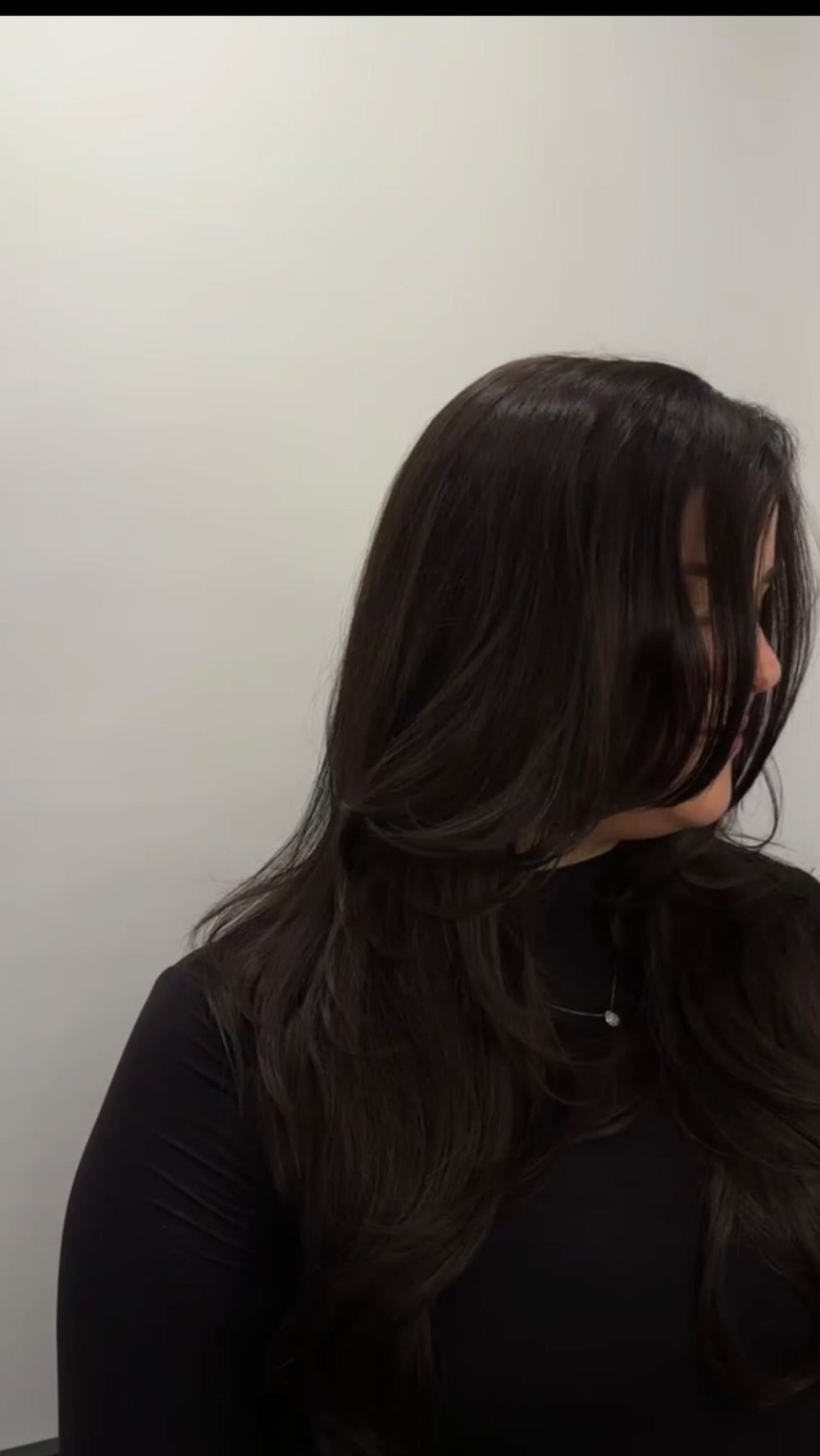
What does it mean to blend gray instead of covering it?
Blending means we soften your gray so it reads as dimension rather than a hard stripe at your part. Instead of matching every strand to one flat shade, we let some of your natural brightness show through in a controlled way.
This can be done with a single process formula mixed for a softer result, or with fine highlights that break up the line where gray grows in. Our half head highlights are a common way to do that around the part and hairline. The payoff is a grow out that looks intentional. You'll still see regrowth, but it won't jump out at you the same way.
Gray coverage options side by side
- Single process color. What it does to gray: Covers it fully at the root. Best for: Clients who want every gray gone. How it grows out: Visible line as new growth comes in.
- Blending. What it does to gray: Softens it into dimension. Best for: Clients who want a lower maintenance look. How it grows out: Soft, gradual regrowth.
- Gloss. What it does to gray: Tones it down and adds shine. Best for: Early or scattered gray. How it grows out: Fades gently with washing.
Can a gloss take care of my first few grays?
A gloss can tone down early or scattered gray, but it won't give you full coverage. It's a demi permanent color that deposits tone or depth with one shade, so it softens gray and blends your root without fully hiding it.
That makes it a nice fit if you're just starting to spot a few silver strands and don't want to commit to a permanent root routine yet. It also adds shine and fades gradually, so there's no sharp line as it wears off. Our hair gloss page has the details, and our guide on what a hair gloss does and who it's for goes deeper.
Gray isn't something we need to hide. It's one more tone we get to work with.
Dubé New York
How often will I need to touch up my roots?
It depends on your contrast and your option. Full coverage on dark hair shows regrowth soonest, and many clients with that look come back every four to six weeks. Blended gray usually stretches longer, since the root line is softer to begin with. A gloss fades a little with each wash, so you refresh it when your tone starts to look dull.
Once we have your formula on file, existing clients can book an Express Grey Retouch. It covers the root without a blowdry, so you can head right back to your day.
What if my ends look faded or don't match my roots?
Add a gloss to your root appointment and we'll pull tone through your mids and ends while the root is covered. Everything matches again by the time you leave.
If your lengths were lightened in the past and you now want them deeper, that's a different job. A tint back rebuilds depth across lightened hair so it doesn't turn flat or murky when it goes darker.
How do we pick the right option together?
We start with a conversation about how you feel about your gray right now. Some clients want every strand gone. Others want it softer and easier to live with. Tell us about any box color, recent lightening, or color that faded fast, and bring photos of looks you like.
New to the salon? A complimentary consultation, in person or by video call, lets us see your hair and point you to the right booking. After any visit, if something isn't right, let us know within one week and we'll schedule a complimentary correction. Current pricing for every color service is on our Service Menu.
Your gray coverage questions, answered
Is permanent color the only way to fully cover gray?
For full, lasting coverage, yes, permanent color at the root is the most reliable option. Demi permanent color like a gloss softens gray and adds shine, but it gradually fades and won't hide every strand. If complete coverage matters most to you, single process color is the booking to choose.
Will blending my gray make me look like I have highlights?
It can, in a subtle way. Blending lets some brightness show through, so your hair reads as dimensional rather than one flat shade. We control how much contrast you see. Tell us if you want it to look like your natural color or more like soft highlights, and we'll formulate for that.
Can I switch from full coverage to blending later?
Yes. Many clients move from full coverage to a softer blend over time. The change is usually gradual, since the color already on your lengths has to grow or fade out. Bring it up at your next visit and we'll plan the transition so it looks deliberate the whole way.
Does gray hair feel different after coloring?
Gray strands are often coarser and can feel drier than pigmented hair. Color doesn't change that texture much, but good aftercare helps. Use a shampoo made for color treated hair, rinse with cooler water, and protect your hair from heat. Ask us which products suit your hair.
What should I avoid before a gray coverage appointment?
Skip at home color in the weeks before your visit, and let us know about any you've used in the past. Box color can change how your hair takes the formula. Come with your hair as it normally is, and bring photos of the shade you want.
Ready to talk about your gray?
Book a complimentary consultation or book online for single process color. See the Service Menu for current pricing.